
Last week, The Telegraph (Connington, 2015) posted an online quiz challenging their readers: ‘could you pass the 11plus?’ As of the 20th February, over 25,000 people had participated in the test and the results have shown some interesting results. According to James Connington, English came out strongest with 87% of people identifying the correct answers. However, on the second set of verbal reasoning and the following non-verbal reasoning questions, only 26% managed to select the right answer and many simply discontinued the quiz – does this challenge the claims that 11plus entrance exams are really tutor-proof?
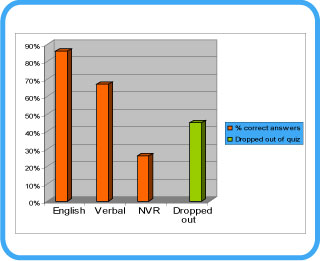 The majority of comments that came back to the quiz via social media noted how they had failed the test despite passing the 11plus exam when they were children. If anything, this demonstrates not only how difficult the entrance exams have become (perhaps in order to tackle rising competition) but also how verbal AND non-verbal reasoning questions require practice as well as specific skills and techniques to tackle these types of questions.
There is a lot of debate about how ‘tutor-proof’ the 11plus exams are but it is important to note that no exam can be entirely tutor-proof. In fact, not preparing in some form or another for an entrance test could be compared to taking a driving test without any lessons. You wouldn’t expect children to take any other form of exam without revising or practising the required skills.
In 2014, The Guardian stated that the current 11 plus exams only test the children on skills that are already being taught in primary schools (Reidy, 2014) and they concluded that private tuition is not required. However, the simple fact is, that unless a primary school teacher is prepared to differentiate year five lessons to the point of frequently exploring secondary level topics, whilst simultaneously teaching definitive techniques for tackling verbal and non-verbal reasoning (which has no mention in the primary curriculum), then the skills required for the new exams are not being taught in primary schools. Moreover, the inequality of children’s educational experiences within schools means that even preparation of topics which are seen on the primary curriculum can be extremely varied.
The truth is, children can prepare for the type of questions that may come up in the 11 plus exam and in doing so may even extend their current abilities to a point that demonstrates their suitability for a Grammar school place. The more familiar you become with a topic, the easier it is to approach, and as non-verbal reasoning is not taught in schools these skills must be obtained elsewhere. Furthermore, if the article in The Telegraph demonstrates how adults struggled to attempt NVR questions (being unfamiliar and therefore lacking in the techniques required to pass) then a child will certainly struggle not having seen these questions before.
KSOL carry out extensive research every year to make sure that their online programmes and mock exams are up to date and as close to the real thing as possible. However, by building from first principles on all of the key topics, KSOL ensure that children will be able to undertake any test confidently, despite changes to exams.
If your child needs help improving their Maths, English, Verbal or Non-Verbal Reasoning skills, visit the KSOL website to view our Online Graduate course and Revision Books.
© Copyright 2015- Key Stages Online
Sources:
Connington, J. 2015. 11 plus results: how did Telegraph readers fare? [Online] [Accessed: 24/2/2015] Available at: <http://www.telegraph.co.uk/education/educationnews/11425086/11-plus-results-how-did-Telegraph-readers-fare.html>
Reidy, T. 2014. New Grammar School test thwarts ‘Pushy Parents’. [Online] [Accessed: 24/2/2015] Available at: <http://www.theguardian.com/education/2014/feb/08/grammar-selective-schools-exam-tutors>


