
What is Pupil Premium?
Pupil Premium is a policy that was pushed through by the Liberal Democrats in April 2011. The aim was to raise the achievement of disadvantaged children and close the gap between them and their peers.
Over the last year, funding for pupil premium has increased dramatically, with over £2.5 billion going towards supporting children registered as eligible for free school meals (at any point in the past 6 years) or for those who have been in care. As a result, schools can now receive around £935 per pupil premium student.
What do we know?
In 2014, many schools in Birmingham and Warwickshire (including the King Edward VI Grammar Schools) opened up additional places (in some cases, as many as 30 places) to accommodate an extra class of children. Later in the year, it was announced that a number of grammar schools would be increasing their pupil premium places; the KE foundation also introduced an initiative that resulted in them offering ‘familiarisation sessions’ to children in over 60 primary schools, in an attempt to better prepare them for the 11plus examination.
Did it work?
After the release of school offers in early March 2015, researchers at KSOL noted a significant rise in cut off scores for children not applying through pupil premium. However, for pupil premium students, cut off scores were significantly lower indicating that grammar schools made their places more accessible to disadvantaged children.
Case Study of King Edward VI Camp Hill Boys: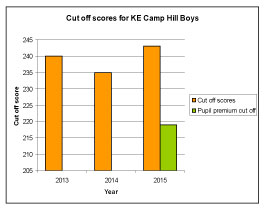
- In 2013, KE VI Camp Hill School for Boys offered 93 places. Their cut off score for applicants sat at 240.
- In 2014, an additional 27 places opened up and the cut off score dropped to 235.
- Late 2014, pupil premium was introduced to students coming from disadvantaged backgrounds
- 2015: Cut off scores for children not applying through pupil premium rose to 243.
- 2015: Children applying through pupil premium had to meet scores of 219.
Figures released in The Independent have confirmed that 20% of Camp Hill Boys new intake have been given to pupil premium children, which is a significant rise on the previous intake and means that all spaces allocated to pupil premium students have been taken up. This indicates that the policy has indeed been a success.
In conclusion, Director of Education Anita Dhunna has said:
“It is likely that with the success of pupil premium this year, and the familiarisation sessions taking place in primary schools, grammar and independent schools will continue to become over-subscribed, making the process more difficult for all children.”
She also went on to explain that:
“Should this be the case, we believe that every child who is considering grammar or independent school should be provided with equal resources including a structured educational framework to sit the 11plus.”
KSOL is an award-winning provider of 11 plus education with over 10 of years experience of teaching children. To find out more visit www.ksol.co.uk or call 01217336558.
© Copyright 2015- Key Stages Online


One thought on “Pupil Premium: Has it worked?”