
At the end of January 2015, The Department of Education published the performance league tables for secondary education in the UK. Gloucestershire schools faired very well with 60.8% of pupils achieving 5 GCSE passes (grades A-C), 4.2% higher than the national average (BBC Education).
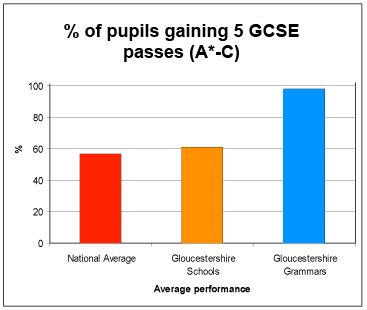 Additionally, at the very top of the ranking, was Gloucestershire school, Pate’s Grammar School. With 100% of students attaining A*-C’s in English and Maths, these results indicate the impressive standards that Grammar schools can achieve. In fact, Gloucestershire hosts 7 Grammar schools, and all attained scores of 96% and above in Maths and English (with grades of A*-C).
When deciding on secondary education for your child, many of you may ask:
What sets Grammar schools apart from the rest?
Well, the GCSE and A level results are certainly a powerful selling point, but what else creates such an appeal for this type of school?
Firstly, and most importantly, distance and income are not necessarily the deciders for admission. Pupils hoping to attend Grammar Schools have to take the 11 plus exam, which is designed to test a child’s intelligence. There are two main reasons why this is such an appeal; one is that it results in like-minded children going to the same school. Another reason is that children with high abilities from disadvantaged backgrounds, actually have the chance to receive high quality education. In fact, a study conducted by Cambridge University found that basing admission on location was one of the biggest drivers of inequality between rich and poor families. Furthermore, the introduction of admissions policies, which make allowances for children registered for free school meals in certain Grammar Schools, has created even more opportunity for disadvantaged children.
Secondly, people choose Grammar schools because they offer more opportunity for students. The array of extra-curricular activities cover all sports, drama, music and technology. There are also a wide range of societies for children to join in science, maths, chess, public speaking, young enterprise etc and many of these actively engage in national competitions.
Clearly, with such outstanding results, Grammar schools should be allowed to continue their popularity, assuring their continued existence in the current social and political climate. With this in mind, you may ask:
With such demand for these schools, how can I ensure that my child gains a place?
In short, the answer is preparation. It is a commonly held belief that the 11 plus exam is tutor-proof; this is especially so with CEM exams. However, all 11 plus exams follow a syllabus (just like any other exam) so when it comes down to it, children can use tutors to help improve weaker areas. It is also important for children to learn how to tackle Verbal and Non Verbal Reasoning, as these are not taught in schools.
Another key element is to enrol your child onto a mock exam. Sitting a practice examination can really help a child to become familiar with the process and build confidence in sitting a formal paper in a serious environment.
For more information on KSOL mock exams running in Gloucestershire, Visit www.ksol.co.uk or call us on 0121 733 6558.
© Copyright 2015- Key Stages Online
Sources:
Coughlan, S. 2014. The Persistent appeal of Grammar Schools. [Accessed on 5/3/2015] Available at: <http://www.bbc.co.uk/news/education-30483031>
Dept for Ed. 2015. School and College performance tables. [Accessed on 6/3/2015] Available at: http://www.education.gov.uk/cgi-bin/schools/performance/group.pl?qtype=LA&no=916&superview=sec
Richardson, H & Sellgren, K. 2015. School performance in England’s local authorities. [Accessed on 5/3/2015] Available at <http://www.bbc.co.uk/news/education-31023685>


